
ExperienceEgypt
Abu Simbel Tour
Ramses II's rock-cut temples on Lake Nasser, by road or air.
- Duration
- Full day
- Category
- Historic
- Country
- Egypt
- Languages
- English, Arabic
- Duration
- Full day
- Category
- Historic
- Country
- Egypt
- Languages
- English, Arabic
- Available as
- Private · Small group
- Pickup
- Pick-up 04:00 from Aswan hotels or cruise vessels for the road convoy; 05:30 for the flight option. Overnight programmes are available on request.
- Pricing
- Price on Request
Overview
The story
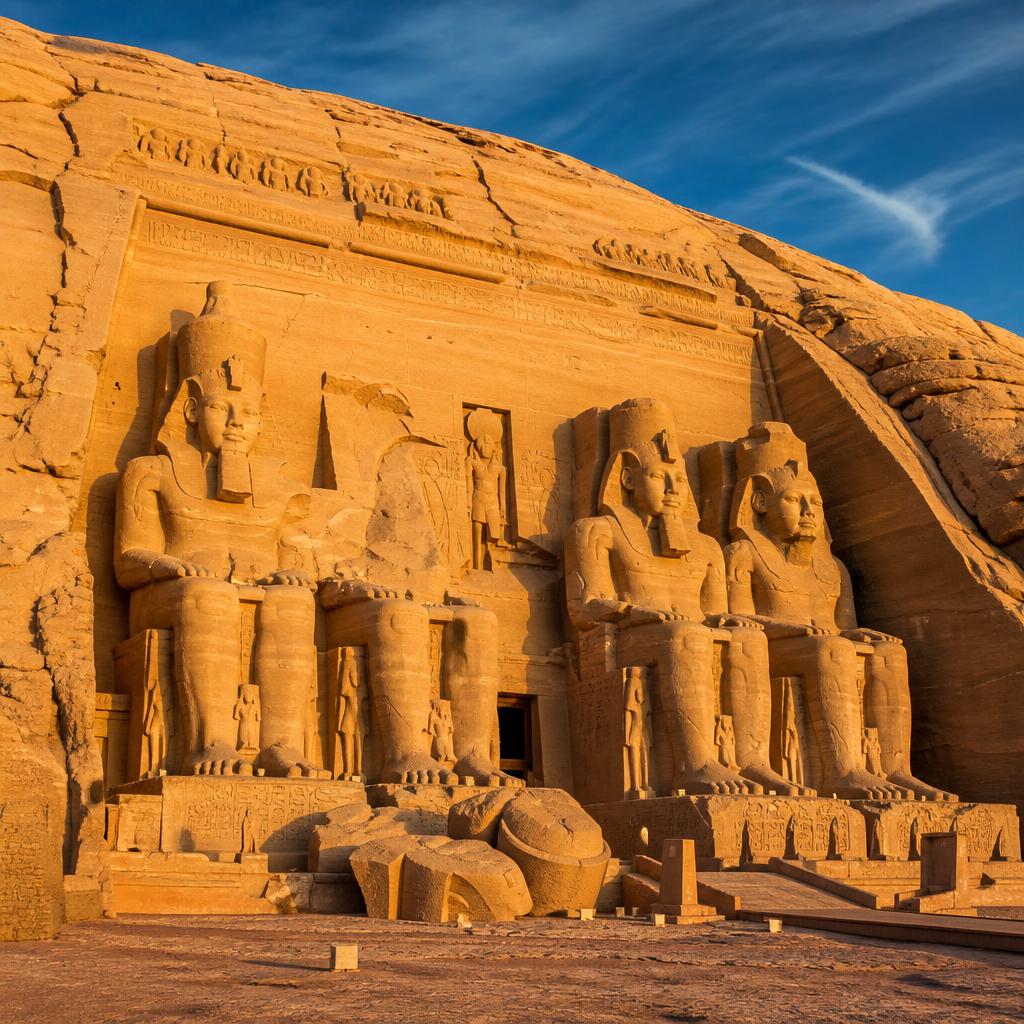
The temples of Abu Simbel are the great southern statement of the pharaonic state — Ramses II’s message to Nubia, carved into a sandstone cliff two hundred and eighty kilometres south of Aswan. When the rising waters of Lake Nasser threatened to submerge them in the 1960s, UNESCO led one of the great engineering feats of the twentieth century: the temples were cut into a thousand blocks and reassembled sixty-five metres higher on the new shoreline. This private, expertly guided visit delivers the temples in their proper setting — and in the light that Ramses’ architects designed them for.
Day 1: Your journey begins pre-dawn — typically 04:00 — from your Aswan hotel or cruise vessel, either by convoy along the desert road (a three-hour drive each way through the Nubian Desert) or, more comfortably, by short direct flight from Aswan Airport. Your Egyptologist accompanies you throughout and begins the interpretation on the drive or flight: the geopolitics of the New Kingdom, Ramses II’s sixty-six-year reign, his campaigns against the Hittites, and his marriage to Nefertari, for whom the smaller temple was built.
Morning: You arrive at Abu Simbel in the early morning, when the light strikes the four seated colossi of Ramses II at the entrance to the Great Temple head-on — the moment the temple was designed for. Your guide walks you through the pillared hall, where eight further colossi of Ramses as Osiris flank a central axis, and into the second hall and the sanctuary itself. Twice each year — on 22 February and 22 October — the sun aligns with this axis and illuminates three of the four seated gods in the sanctuary at dawn; a phenomenon that has fascinated astronomers and Egyptologists for two centuries.
Afternoon: You then move to the smaller temple, dedicated to Hathor and to Queen Nefertari, whose statues at the façade stand at the same height as those of her husband — an honour without precedent in Egyptian royal art. Inside, the pillars are Hathor-headed and the reliefs are among the most tender in pharaonic art. Your guide will point out the coronation scene in which Nefertari is crowned by the goddesses Isis and Hathor.
Evening: You return to Aswan by mid-afternoon (flight) or by late afternoon (road). Overnight stays at the small hotels beside Lake Nasser can be arranged for those who wish to attend the sound-and-light performance at the temples or witness a second dawn visit.
Photography inside the temples requires a permit and the use of flash is prohibited. Practical advice: dress lightly and modestly, wear closed shoes, and prepare for a very early start; the road option can be tiring, and the flight option is strongly recommended for older travellers, families with young children or guests with limited mobility. Family suitability is excellent from age seven upward. The site is largely accessible; the flight option removes almost all mobility barriers. Best months are October through April; the biannual sun-alignment dates fill quickly and must be booked months ahead.
Highlights
Moments to remember
- 01Great Temple of Ramses II (four colossi façade)
- 02Interior hall of eight Osiride colossi
- 03Sanctuary of the four seated gods
- 04Small Temple of Hathor & Nefertari
- 05The reassembled shoreline of Lake Nasser
Detailed Itinerary
Day by day
- 01Day 1
Your journey begins pre-dawn — typically 04:00 — from your Aswan hotel or cruise vessel, either by convoy along the desert road (a three-hour drive each way through the Nubian Desert) or, more comfortably, by short direct flight from Aswan Airport. Your Egyptologist accompanies you throughout and begins the interpretation on the drive or flight: the geopolitics of the New Kingdom, Ramses II’s sixty-six-year reign, his campaigns against the Hittites, and his marriage to Nefertari, for whom the smaller temple was built. Morning: You arrive at Abu Simbel in the early morning, when the light strikes the four seated colossi of Ramses II at the entrance to the Great Temple head-on — the moment the temple was designed for. Your guide walks you through the pillared hall, where eight further colossi of Ramses as Osiris flank a central axis, and into the second hall and the sanctuary itself. Twice each year — on 22 February and 22 October — the sun aligns with this axis and illuminates three of the four seated gods in the sanctuary at dawn; a phenomenon that has fascinated astronomers and Egyptologists for two centuries. Afternoon: You then move to the smaller temple, dedicated to Hathor and to Queen Nefertari, whose statues at the façade stand at the same height as those of her husband — an honour without precedent in Egyptian royal art. Inside, the pillars are Hathor-headed and the reliefs are among the most tender in pharaonic art. Your guide will point out the coronation scene in which Nefertari is crowned by the goddesses Isis and Hathor. Evening: You return to Aswan by mid-afternoon (flight) or by late afternoon (road). Overnight stays at the small hotels beside Lake Nasser can be arranged for those who wish to attend the sound-and-light performance at the temples or witness a second dawn visit. Photography inside the temples requires a permit and the use of flash is prohibited. Practical advice: dress lightly and modestly, wear closed shoes, and prepare for a very early start; the road option can be tiring, and the flight option is strongly recommended for older travellers, families with young children or guests with limited mobility. Family suitability is excellent from age seven upward. The site is largely accessible; the flight option removes almost all mobility barriers. Best months are October through April; the biannual sun-alignment dates fill quickly and must be booked months ahead.
Inclusions
What's covered
Included
- Private air-conditioned transport OR return flight (option-dependent)
- Licensed Egyptologist guide
- Abu Simbel entrance ticket
- Bottled water
- Hotel or cruise vessel pick-up and drop-off in Aswan
Not Included
- ·Flight upgrade (if choosing road, or vice versa)
- ·Photography permit inside the temples
- ·Meals
- ·Gratuities
Begin the Journey
Ready to plan Abu Simbel Tour?
Share a few details and our team will return a tailored proposal within one business day.
Practical information
- Pickup
- Pick-up 04:00 from Aswan hotels or cruise vessels for the road convoy; 05:30 for the flight option. Overnight programmes are available on request.