
The climate in the UAE
To those who live there, the climate in the UAE consists of only two seasons: hot and hotter. Or summer and hot summer. The reality, of course, is more nuanced. The country is characterized by hot and sunny summers with humidity levels that can make being outdoors unbearable. That said, the pleasant and mild winters bring great relief. However, the transitional seasons of autumn and spring have their own distinct features, not least of which are dust storms and rain.

At the height of summer, temperatures in the UAE hover around the 50-degree mark. This typically prompts residents to spend the entire day – and night – indoors, where air-conditioning helps maintain more convivial levels. Expats from colder countries who are attracted by the year-round sunshine and relocate to the UAE often find this inversion the hardest adaptation of all. As a result, they often seek holidays to snowy or rainy destinations.
Climate change has wrought several changes in recent years, as have weather management techniques such as cloud seeding. Nevertheless, dust storms remain a fairly regular occurrence, while the odd snowstorm keeps things interesting.
Flanked by the Persian Gulf and the Gulf of Oman, the north of the country is ridged by the Hajar Mountains, while the Rub’ Al Khali desert sits to the southwest. This geographical diversity means that temperatures across the UAE’s seven constituent emirates can vary by about five degrees. Most urban areas are sited along the coast and see humidity levels reach up to 85%, particularly in the summer. Inland areas, meanwhile, are significantly drier. The summer heat is easier to endure in the northern mountain areas, which also see more rain in the winter months.
Dust storms
The climate in the UAE is also characterized by frequent sandstorms. These typically occur over the summer and during periods of seasonal change, particularly as winter moves into spring.
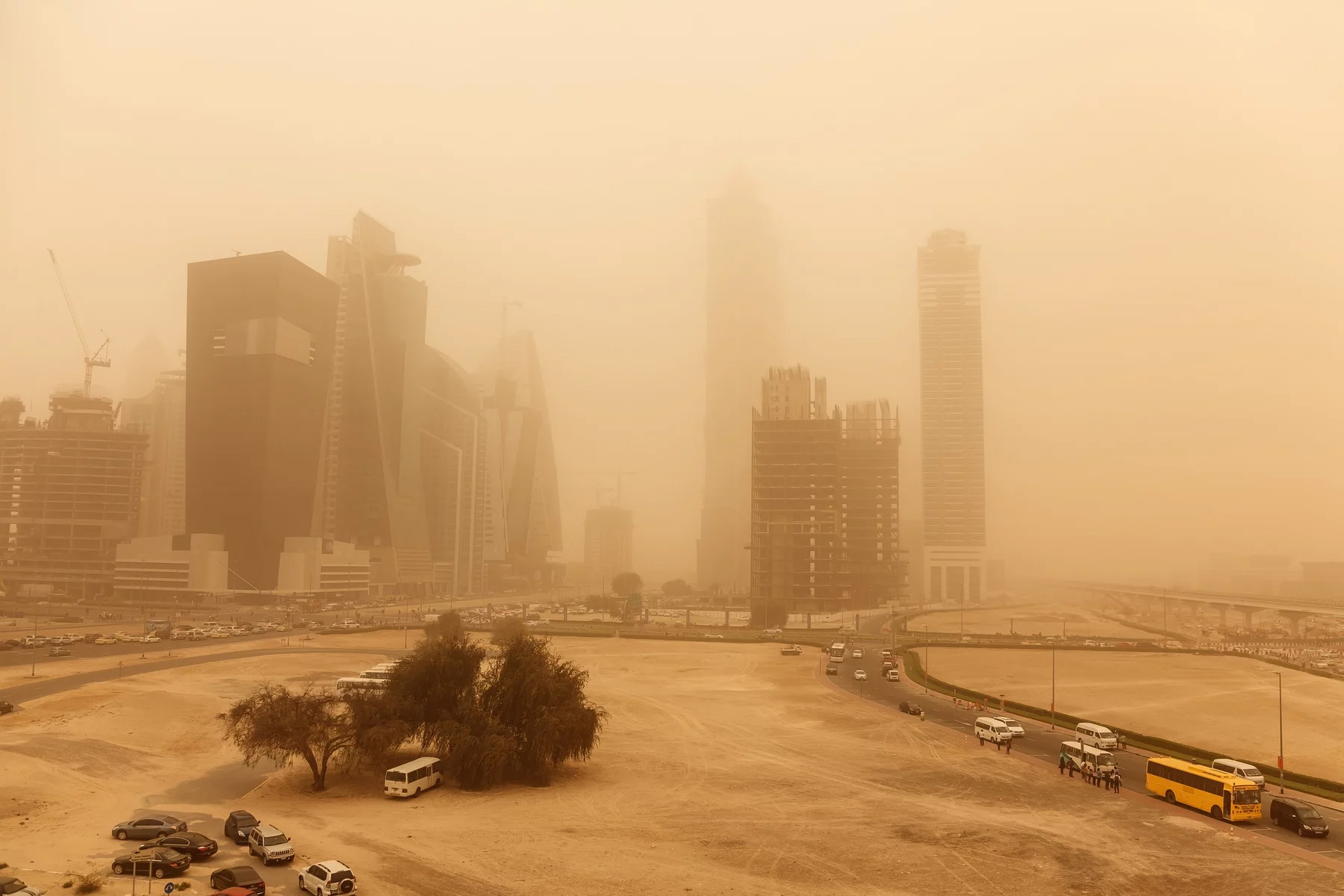
At such times, visibility drops to a couple of hundred meters. Many residents also report increased incidents of allergy and asthma attacks. Sandstorms in the UAE usually comprise a mix of silica crystals as well as viruses, bacteria, fungi, dust mites, and even plants; all of which can remain suspended in the air for a few days at a time.
Thankfully, the country doesn’t experience the kind of severe squall seen in Tom Cruise’s Mission Impossible: Ghost Protocol, which was set in Dubai. Other parts of the region, such as Saudi Arabia, Kuwait, and Iraq, experience the worst storms, as they often experience strong north-westerly winds. That said, the 2017 UAE Climate Change Risks & Resilience report forecasts that global warming will likely trigger more sandstorms in the future.
UAE climate averages
The UAE is located on the boundary between the earth’s tropical and subtropical zones, with a climate to match. Average temperatures in the country’s capital city, Abu Dhabi, range from 18 degrees Celsius in January to 35 in August. Further south in Dubai, the mercury rises to a degree higher on average throughout the year. Snow, then, is not a concern. As a matter of fact, snowfall in the UAE has only occurred three times since records began: in 2004, 2009, and 2017.
For the most part, residents don’t need to bother with an umbrella in the UAE. The average annual rainfall in the coastal areas is less than 120mm per year; although that can treble in some mountainous regions. Like in most tropical regions, rain falls in short, torrential bursts. Therefore, flash floods in the ordinarily dry riverbeds and along the streets are not uncommon – thanks to sand-clogged drainage systems.
Wind, on the other hand, can be a bother, depending on the direction it arises from. The sharqi – a humid, south-eastern gale – can overwhelm the coastal areas in the summer. Similarly, the shamal – a cool north-westerly wind which predominates during the winter months – can be accompanied by sand.
Overall, though, the dependably sunny climate in the UAE has turned it into a popular tourist destination. Visitors and residents alike can count on sunshine every day, except February to April; when there are 27 days of sun on average.


Comment (0)